

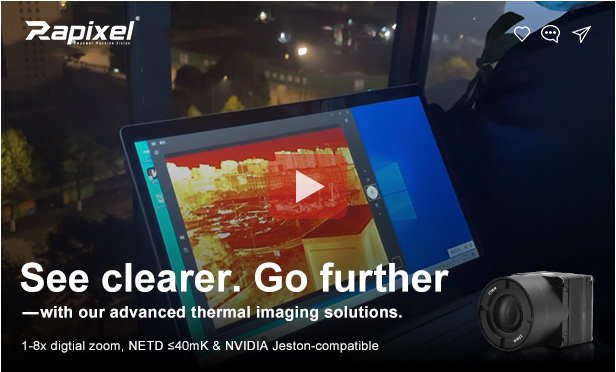
When you think about image quality, resolution probably comes to mind first. But in thermal imaging, there's a less obvious hero behind sharp, detailed visuals—thermal sensitivity, better known as NETD (Noise Equivalent Temperature Difference).
What Is NETD, and Why Should You Care?
Imagine you're looking through a thermal camera on a foggy night. Everything seems murky. But one camera shows more contrast and detail than another. Why?
That’s NETD at work.
NETD measures a camera’s ability to detect small temperature differences in a scene. The lower the NETD (measured in millikelvins, or mK), the more sensitive the camera is—meaning it can “see” finer temperature differences and render more detailed thermal images.
Think of NETD like the contrast dial on your TV. Turn it down (lower mK), and the shadows and textures pop. Turn it up (higher mK), and everything starts blending together.
Cooled vs. Uncooled: Sensitivity vs. Simplicity
Historically, only cooled infrared cameras could achieve ultra-low NETD values, sometimes dipping below 20 mK. These systems offer phenomenal sensitivity, making them ideal for scientific research, aerospace, or long-range surveillance.
But there's a trade-off:
| Cooled Cameras | Uncooled Cameras |
|---|---|
| Ultra-sensitive (NETD < 20 mK) | Now reaching NETD < 30 mK |
| Bulky, expensive | Compact, cost-effective |
| High maintenance | Low power, no cryocooler |
| Fast startup | Instant-on readiness |
Today’s uncooled LWIR (Long-Wave Infrared) sensors have made impressive strides. Some modern microbolometers can now achieve NETD values once reserved for cooled systems—making high sensitivity more accessible than ever.
What Does “Good Sensitivity” Actually Mean?
Here's a quick guide:
| NETD(mK) | Thermal Sensitivity Rating | Image Clarity |
|---|---|---|
| < 30 mK | Excellent | Crisp detail, even in low contrast |
| 40–49 mK | Very Good | Great for general-purpose use |
| 50–59 mK | Good | Adequate, but detail may suffer in fog or smoke |
| 60–69 mK | Fair | Usable, but lacks refinement |
| 70–80 mK | Basic | Acceptable for non-critical tasks |
Rule of Thumb: The lower the NETD, the better your camera can detect fine thermal differences—crucial in challenging environments like fog, dust, smoke, or long-range observation.
Seeing the Invisible: Real-World Impact
Let’s say two cameras each have a resolution of 640 × 480 pixels. One has NETD of 20 mK, the other 50 mK.
-
In a warm office, both might look similar.
-
But in a smoky tunnel or misty forest?
-
The 20 mK camera captures subtle human outlines or machinery heat signatures.
-
The 50 mK camera shows blobs—enough for detection, not for detail.
-
This matters in fields like:
-
Border security
-
Drone-based inspection
-
Early fire detection
-
Search and rescue
-
Industrial leak monitoring

Bottom Line: Don’t Just Ask About Pixels
In thermal imaging, resolution tells you how many pixels you have. NETD tells you how useful they are.
A sharp thermal image comes not just from more pixels—but from more sensitivity.
When choosing a thermal imaging module, always ask:
-
What’s the NETD?
-
What conditions will I be operating in?
-
Do I need detail in dust, fog, or low-contrast scenes?
The answers may lead you to reconsider your definition of “high quality.”
Ready to Explore?
Modern thermal imaging is more powerful and accessible than ever. Whether you're integrating into a drone, sensor pod, or industrial system, understanding NETD is your first step to smarter vision.
Share:
How Industrial Cameras Revolutionize Pharmaceutical Quality Control
Rolling vs Global Shutter in sCMOS Cameras