

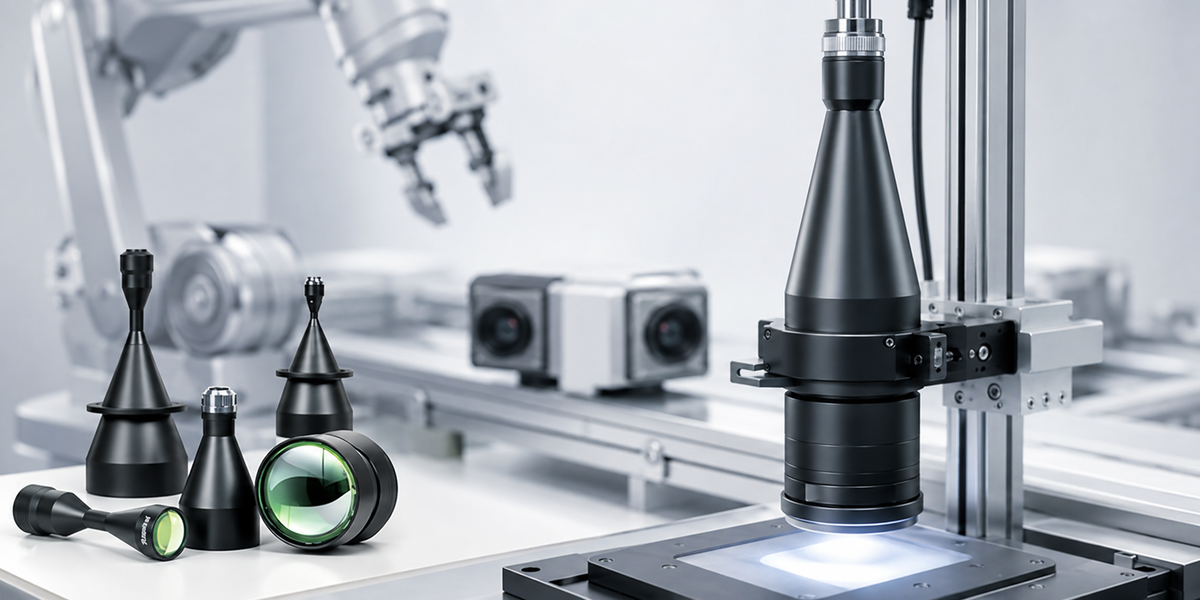
What Is a Telecentric Lens? A Practical Guide for Machine Vision
Learn how telecentric lenses reduce perspective-related errors, stabilize magnification, and improve imaging consistency for precision measurement, AOI, and industrial inspection.
What Is a Telecentric Lens?
A telecentric lens is an optical lens designed to maintain highly stable magnification over a defined object-space range while minimizing perspective-related changes in image size. This makes telecentric imaging especially useful for machine vision applications where dimensional accuracy, repeatability, and geometric consistency are important.
In industrial machine vision, a sharp image is not always enough. When a camera is used to measure or inspect a part, the image must also represent the object's geometry consistently.
This is where a telecentric lens can make a significant difference. Unlike a conventional machine vision lens, a telecentric lens is designed to minimize perspective-related changes in magnification within its specified operating range.
The result is more stable imaging when object position changes along the optical axis—an important advantage for precision measurement, automated optical inspection (AOI), and other demanding vision applications.
In This Guide
- Why Perspective Distortion Matters in Machine Vision
- What Makes Telecentric Imaging Different?
- Telecentricity vs Low Distortion
- Telecentric Lens vs Standard Machine Vision Lens
- When Should You Use a Telecentric Lens?
- Key Telecentric Lens Parameters
- How Camera and Lens Work Together
- Why Lighting Matters in Telecentric Imaging
- Common Telecentric Lens Applications
- How to Start Choosing a Telecentric Lens
- Frequently Asked Questions
1. Why Perspective Distortion Matters in Machine Vision
Perspective is a natural part of conventional imaging. Objects that are closer to the lens appear larger, while objects farther away appear smaller. For photography, this effect is often desirable. For precision machine vision, however, it can introduce unwanted variation.
Consider an inspection system measuring the width of a small mechanical component. If the component moves slightly closer to or farther from a conventional lens, its apparent size can change in the image. Even when the physical part has not changed, the measured image dimensions may vary.
Object Position Changes
The inspected part moves closer to or farther from the lens.
Apparent Size Changes
Perspective can cause the same physical feature to appear different in size.
Measurement Variation
Changes in image geometry can affect dimensional inspection and repeatability.
For applications where image geometry must remain consistent, reducing perspective-related magnification changes becomes an important part of optical system design.
2. What Makes Telecentric Imaging Different?
Telecentric imaging uses a specialized optical design to reduce changes in magnification caused by object-position variations within a defined telecentric range.
In practical terms, this means that when an object moves along the optical axis within the lens's specified operating range, its apparent size remains much more stable than with conventional imaging.
Perspective Changes
Object distance can affect apparent object size and image geometry.
Stable Magnification
Magnification remains highly stable within the specified telecentric object-space range.

3. Telecentricity vs Low Distortion
Telecentricity and optical distortion are related to image quality, but they describe different characteristics. This distinction is important when selecting a lens for machine vision measurement.
A low-distortion lens can minimize geometric distortion while still producing perspective-related changes in magnification. A telecentric lens is specifically designed to reduce perspective effects over its specified object-space range.
| Characteristic | Low-Distortion Lens | Telecentric Lens |
|---|---|---|
| Geometric Distortion | Designed to be low | Typically very low |
| Perspective Effect | Still present | Strongly reduced |
| Magnification Stability | Limited | High |
| Typical Use | General imaging and inspection | Measurement and precision inspection |
4. Telecentric Lens vs Standard Machine Vision Lens
A standard machine vision lens is suitable for many general inspection applications. A telecentric lens becomes more valuable when the system requires stable magnification, repeatable geometry, or accurate dimensional inspection.
| Feature | Standard Lens | Telecentric Lens |
|---|---|---|
| Perspective Effect | Present | Strongly reduced |
| Magnification Stability | Limited | High |
| Dimensional Measurement | General applications | Precision applications |
| Edge Inspection | Good | Highly suitable |
| Typical Application | General machine vision | Precision inspection and measurement |
5. When Should You Use a Telecentric Lens?
Not every machine vision system requires a telecentric lens. The strongest use cases are applications where image geometry, measurement consistency, and repeatability are critical.
Precision Measurement
Dimensional inspection of widths, diameters, holes, edges, and components.
AOI Inspection
Repeatable imaging for automated optical inspection systems.
High-Resolution Imaging
Precision imaging systems using high-resolution industrial cameras.
Variable Object Position
Inspection where object height or position may vary within the imaging range.
6. Key Telecentric Lens Parameters
Selecting a telecentric lens should start with the inspection requirements rather than the lens model. Several optical and mechanical parameters need to be considered together.
Define the physical dimensions of the inspection area.
Determine how much of the object must be captured.
Match the object size with the camera sensor.
Confirm the required mechanical installation distance.
Ensure the lens adequately covers the camera sensor.
Match lens performance with camera pixel size and resolution.
Important for accurate geometric measurement.
Consider object height variation and focus requirements.
7. How Camera and Lens Work Together
A high-resolution camera does not automatically create a high-resolution machine vision system. The optical performance of the lens must be appropriate for the camera sensor and inspection requirements.
Sensor & Resolution
Sensor size, pixel size, resolution, and shutter characteristics influence system performance.
Optical Performance
Magnification, FOV, working distance, resolution, and distortion must match the camera and object.
Final Image Quality
Camera and lens should be evaluated as an integrated imaging system.
This becomes particularly important when telecentric lenses are paired with high-resolution area scan cameras for demanding AOI and measurement applications.
8. Why Lighting Matters in Telecentric Imaging
A telecentric lens cannot compensate for unsuitable illumination. Even when image geometry is highly stable, poor lighting can reduce contrast, hide defects, or make edges difficult to detect.
Lighting geometry should therefore be considered together with the lens. This is particularly important when inspecting reflective metals, precision components, small edges, holes, or other features where contrast and edge definition directly affect inspection results.
See how telecentric imaging and specialized lighting can be combined for automated optical inspection, including compact 90° optical configurations.
Explore Telecentric Lens for AOI →9. Common Telecentric Lens Applications
Telecentric lenses are particularly useful when dimensional consistency, geometric accuracy, and repeatable imaging are important.
Precision Measurement
Dimensional inspection of widths, diameters, holes, edges, and profiles.
AOI
Automated optical inspection of components and manufactured parts.
Electronics
PCB, connectors, IC packages, and electronic components.
Semiconductor
Precision inspection and measurement of semiconductor components.
Mechanical Parts
Inspection of small and precision-machined components.
Plastic Components
Dimensional and edge inspection of molded precision parts.
10. How to Start Choosing a Telecentric Lens
The most reliable way to select a telecentric lens is to start with the inspection object and required imaging performance rather than choosing a lens based only on magnification.
Step 1 — Define the Object Size
Determine the maximum dimensions of the inspection area.
Step 2 — Determine the Required FOV
Make sure the entire inspection area is covered with appropriate margin.
Step 3 — Confirm the Camera Sensor
Check sensor size, resolution, and pixel size.
Step 4 — Select Magnification
Match object size, FOV, and sensor dimensions.
Step 5 — Confirm Working Distance
Make sure the lens fits the available mechanical installation space.
Step 6 — Evaluate Resolution and Distortion
Confirm that the lens can support the required measurement and inspection accuracy.
Step 7 — Select the Lighting
Consider surface properties, reflections, contrast, and the geometry of the inspection system.
Telecentric Lens Solutions for Precision Vision
Rapixel develops industrial machine vision solutions for applications requiring stable imaging, low perspective effects, high resolution, and reliable inspection performance.
Telecentric lens solutions can be integrated with industrial cameras, specialized lighting, and vision systems for precision measurement, AOI, electronic component inspection, and other demanding applications.
Explore Rapixel Telecentric Lenses →Explore the Telecentric Lens Guide
Follow the complete guide from telecentric imaging fundamentals to AOI, lens selection, precision measurement, industrial applications, and complete vision system solutions.
Telecentric Lens Fundamentals
Understand telecentric imaging, perspective effects, magnification, and the fundamentals of telecentric lens selection.
You are hereTelecentric Lens for AOI
Explore telecentric imaging for automated optical inspection, electronics, PCB, and precision component inspection.
Explore AOI Applications →Telecentric Lens Selection Guide
Learn how to select magnification, FOV, working distance, sensor compatibility, and optical performance.
Explore Selection Guides →Telecentric Lens for Precision Measurement
Discover how telecentric imaging supports dimensional measurement, edge inspection, and measurement repeatability.
Explore Measurement Guides →Telecentric Lens for Industrial Applications
Explore telecentric lens applications across semiconductor, electronics, mechanical, plastic, and precision manufacturing.
Explore Industry Applications →Telecentric Vision Systems & Solutions
Learn how cameras, telecentric lenses, lighting, and vision software work together in complete inspection systems.
Explore Vision Solutions →Frequently Asked Questions
What is a telecentric lens?
A telecentric lens is designed to maintain highly stable magnification over a defined object-space range while minimizing perspective-related changes in image size. It is commonly used for precision machine vision applications.
What is a telecentric lens used for?
Telecentric lenses are commonly used for precision measurement, dimensional inspection, AOI, semiconductor inspection, electronics inspection, and other applications where stable magnification and repeatable imaging are important.
What is the main advantage of a telecentric lens?
The main advantage is highly stable magnification over a defined object-space range, which helps reduce perspective-related variation in dimensional imaging and inspection.
Is a telecentric lens better than a standard lens?
Not necessarily. Standard lenses are often more flexible and cost-effective for general inspection. Telecentric lenses are especially useful when measurement accuracy, stable magnification, and geometric consistency are important.
Does a telecentric lens eliminate distortion?
Telecentricity primarily reduces perspective-related magnification changes. Optical distortion is a separate characteristic, so both telecentricity and distortion specifications should be considered for precision measurement.
How do I choose a telecentric lens?
Start with the object size, required field of view, camera sensor size, magnification, working distance, resolution, distortion, and depth of field. Lighting requirements should also be evaluated as part of the complete machine vision system.
Need Help Selecting a Telecentric Lens?
Share your object size, required FOV, working distance, camera sensor, and inspection requirements. Rapixel can help identify a suitable telecentric imaging configuration.
Talk to a Vision Specialist →
Share:
How AI Smart Cameras Simplify Industrial Machine Vision Inspection
Why AOI Need Telecentric Lens?